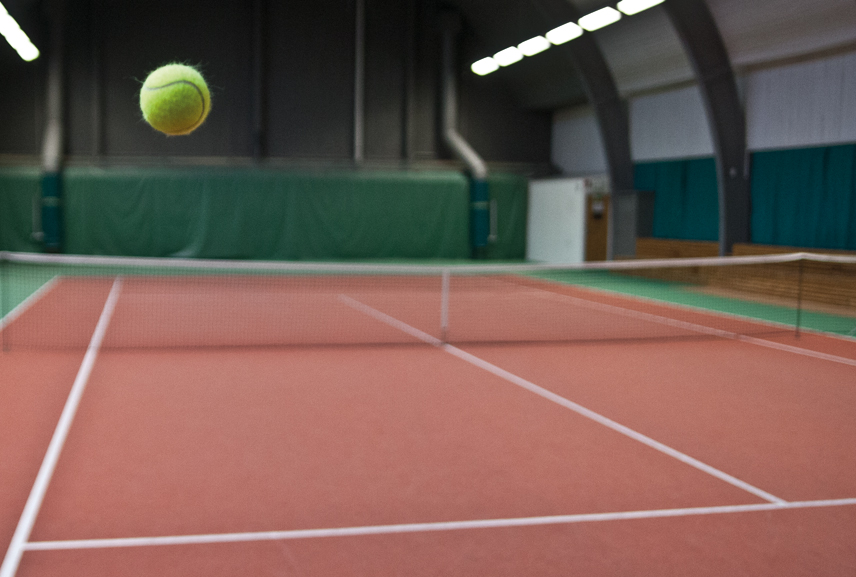
The gym is crowded with students. Further down the hall, lawyers and doctors are playing tennis. The battle of whether or not Gerdahallen’s tennis courts should be remade into gyms has raged for eight years, but now that one of the main combatants is retiring, he has to admit that the battle is lost. The tennis club has won, thanks to vice chancellor Per Eriksson.
When Anders Faager became MD of Gerdahallen in 2005, he had already identified a problem: The gym was swamped with people. There were lines to the machines and all group workouts were fully booked. He looked around. The solution seemed ridiculously simple. Take one, or preferably two, of the tennis courts in Gerdahallen and remake them into gyms.
“The problem with tennis is that you need a lot of space. There are at most four people in an area that could hold 150. It’s obvious that we could make more money and satisfy the needs of our customers if we remade one of the courts,” he says.
Roughly nine years later, February 17 this year, Ander Faager retired. He might have sighed if he had looked around. Because the tennis courts are still there. The ridiculously simple solution turned out to be more complicated than he initially thought. An eight-year long battle with professors, the vice chancellor and tennis enthusiasts was over, and he was the loser. This despite the fact that Anders Faager believed he had both economy and morale on his side.
“The tennis activities run at a loss of a couple of hundred thousand every year. Partly because we have such low fees, and partly because the rent for the courts is so high. So technically the students that work out at Gerdahallen are the ones subsidizing the establishment’s tennis games,” Anders Faager says.
He is not the only one with that opinion. Lundagård has talked to many of the employees at Gerdahallen who agree with Anders Faager. They all wish to remain anonymous.
“A lot of weird things have happened surrounding this issue, so I’m honestly scared that I’d get kicked out of the university. But the employees definitely agree that one of the tennis courts should be remade,” says one of the employees.
Called on vice chancellor
“These are the second oldest tennis courts in Sweden. That’s culture!”
Kent Salomonsson is the chairperson of Gerda tennissällskap, the supporting association that was formed when Anders Faager made his plans for Gerdahallen public. Together with about 200 likeminded friends, he started working to preserve the tennis courts. They wrote debate articles for Sydsvenskan, tried to get the courts national monument protected and started intense lobbying at the university. So when Per Eriksson became the vice chancellor of Lund University, they did not rest on their laurels.
“The board members of Gerda TS note that You, in addition to all other qualifications, are also a devoted tennis player,” they wrote him in a letter and also let him know that he was very welcome in their association.
Most of the members of Gerda TS have one thing in common: They are no longer students at the university. There are some students in the member list, but most of them are professors, doctors and other academics that have long since taken the step into working life. As the tennis players have grown older, and the general interest in tennis has decreased in Sweden, Anders Faager has had more trouble seeing the point of the tennis courts.
Whether the tennis makes a good profit or not is a hard question to answer. Since Gerdahallen is a foundation, their accounts are secret and that leaves only word against word. Anders Faager claims that the tennis activities, generously calculated, run at a loss of a couple of hundred thousand every year. Kent Salomonsson, however, claims that is not true. The tennis actually makes a good profit, depending on how it is calculated. And the frequency of reservation is high.
“It’s wrong to say that the aerobic finances the tennis. The profit gained from the tennis is very high, with the right cost allocation,” he says.
The letter was gone
In 2012, Anders Faager and the other employees at Gerdahallen were ahead in the game. He had convinced many members of Gerdahallen’s board to remake one of the courts into a gym, and a decision was to be made during the spring. The crucial problem was the legal issue. The tennis enthusiasts had claimed that since the donation to the university had been made with the intention that the premises should be used for tennis, none of the courts could be remade. The board has asked Ulla Neppelberg, lawyer and an expert at foundations, to review the case and her answer was unambiguous.
“The way I see it, the board had the possibility to use the courts for other purposes. I didn’t think the tennis players had too much to lean on, and I said so to the board,” she says.
The reason for that is that despite years of searching, no deed of gift could be found. The deed of gift is what determines the purpose of the donation, and without it the tennis club had no case, Ulla Neppenberg argued. The tennis players were not bothered by that, and loudly declared that they would sue Gerdahallen if a court disappeared.
“There are documents from the 1920s that show that these areas were made for tennis and nothing else. The law is on our side, just ask our expert Tore Wiwen-Nilsson,” Kent Salomonsson says.
Does he play tennis with you?
“Well, that’s not what’s important. Yes, he plays, but most importantly, he’s a very good lawyer.”
Vice chancellor put his foot down
Despite the knowledge that they had the law on their side, the tennis players were worried. So they called on Per Eriksson, who had started playing tennis in Gerdahallen, and asked him to stop the plans.
“It is time to act. We are anxiously awaiting positive news from you. If that does not happen within a week, then it is time for us to take decisive action!” Rolf Johannesson, professor at LTH, wrote to Per Eriksson, who in turn assured him that a meeting with the board’s chairperson Håkan Magnusson had been arranged.
And Per Eriksson put his foot down. He forbid the board from making any decision and they had no other choice but to postpone the issue. Eva Frisendahl, who was a student representative on the board, remembers the incident with discomfort.
“The board postponed the issue and I was the only one who dared to oppose it, since I was the only one who had nothing to lose. Leading and powerful forces wanted to keep the tennis,” she says.
Per Eriksson does not agree that he forbid the board from making any decision.
“No, I don’t think I ever expressed myself like that. Sure, everyone can interpret things differently, but I can’t stop the board from making decisions.
There are those who think that you sided with the tennis club in this issue.
“Haha, okay. People can think a lot. I did my best to handle this as correctly as possible, and I appointed several members of the board with clear connections to the university management.”
The battle is history
Per Eriksson refers to the time when the tennis club removed three tennis courts to make room for the gym after the fire at Palaestra, where the gym was housed previously. As far as he is concerned, the tennis battle is over and done with. Kent Salomonsson agrees, and quickly thanks the vice chancellor for his contribution to the battle.
“He’s been important, definitely. He was one of the people who stressed that this is a donation that was meant for tennis.”
“The tennis battle is over now. It’s history, and we are very pleased with that,” he adds.
The chairperson of the board of Gerdahallen, Ingalill Rahm Hallberg, agrees and is noticeably annoyed that the old fuss is dragged back up.
“That’s not a current issue. What we’ve been doing all this time is to critically examine all the documents we have about Gerdahallen and the tennis courts. Our basis has been to put everything in order, and I think this is a very destructive step back.”
Ingalill Rahm Hallberg argues that the issue stopped being about tennis long ago.
“It’s about winning a battle. I’m old enough to know when people can’t remember what they’re fighting for. If you fight a destructive battle, you’re just harming your cause.”
Whether that is true or not, this battle will be fixed in Anders Faager’s mind for some time. According to him, this is a grand example of Lund University at its worst. An establishment who just wants to put its own house in order, rather than think about the students and the future.
“This is a bit like the lundesian way of thinking – don’t come here and change anything.”
Text: Sebastian Hagberg
Translation: Marie Eriksson